
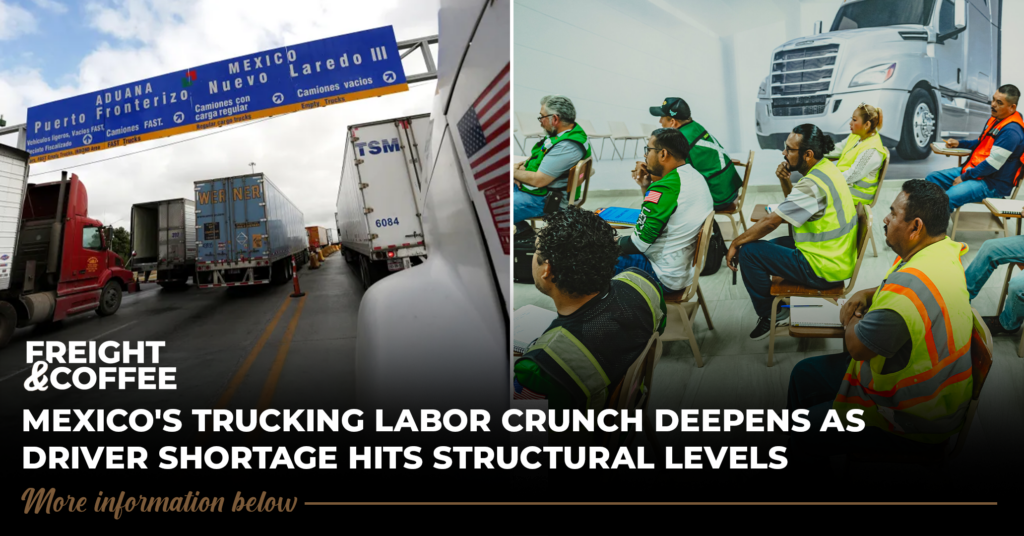
Mexico’s trucking industry is running short on one thing it can’t operate without: drivers. A new survey from the International Road Transport Union (IRU) found that 14% of commercial driver positions in Mexico sit vacant, the second-highest rate among the 18 freight markets surveyed worldwide, behind only Uzbekistan. That’s well above the global average vacancy rate of 11%.
The numbers point to something bigger than a temporary hiring gap. IRU’s report found recruitment difficulties have worsened in nearly every market surveyed since 2021, suggesting the driver shortage has become a structural feature of the industry rather than something tied to freight cycles or economic swings.
Why it matters for Mexico: Trucking moves roughly 81% of the country’s land cargo and 57% of its domestic freight, so a driver shortage doesn’t just squeeze carriers — it ripples out to manufacturers, retailers, and exporters who depend on road transportation to keep goods moving, including across the U.S.-Mexico border. Mexico’s National Chamber of Cargo Transportation estimates around 90,000 trucks are currently idle for lack of qualified drivers, a number that could climb past 108,000 by 2028 without new workforce initiatives.
Mexican fleet operators feel it too: 44% ranked the driver shortage as their single biggest operational challenge, ahead of economic conditions, decarbonization, and digitalization.
The global picture: IRU estimates roughly 2.9 million truck driver positions remain unfilled across the 18 major freight markets it surveyed — about 11% of the entire workforce. Europe posted a 13% vacancy rate, Australia 12%, Brazil 11%, and China 10%.
IRU Secretary General Umberto de Pretto said the shortage has evolved into a structural issue that’s now directly affecting freight capacity, business growth, and supply chain reliability.
The bottom line: Mexico’s labor crunch is part of a worldwide pattern, but its position near the top of the vacancy rankings — combined with how central trucking is to its economy — makes it one of the markets most exposed to the consequences if the trend doesn’t reverse.
Source: FreightWaves, reporting by Noi Mahoney
📦☕ Follow @freightandcoffee on Instagram for daily freight news, breaking supply chain updates, and everything moving in transportation and logistics. 🔗 freightncoffee.com