
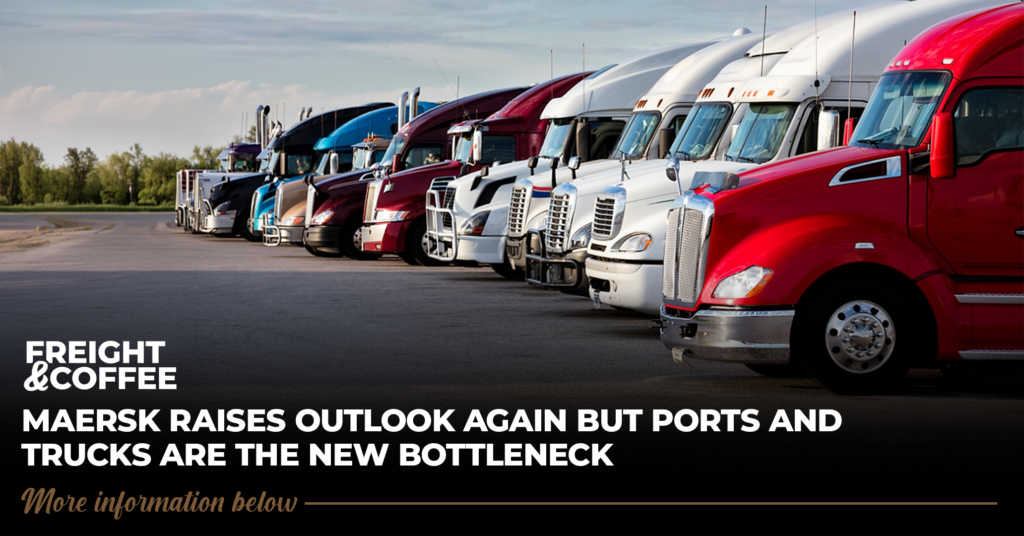
Breaking transportation news, August 13, 2026 — Maersk just delivered one of its strongest quarterly performances of the year, and the market noticed. Shares jumped 7% in European trading Thursday after the Danish shipping giant raised its full-year earnings guidance for the second time in 2026. But beneath the strong numbers, shipping executives are sounding a clear alarm: the next bottleneck in global freight isn’t at sea — it’s on land.
The Numbers
According to reporting by CNBC, Maersk posted preliminary underlying EBITDA of $3 billion for the second quarter, with revenue climbing to $15.8 billion — up 20% year over year. EBIT came in at $1.6 billion, a near-doubling from $845 million in the same period last year, producing a 10% EBIT margin.
The company raised its full-year 2026 guidance to underlying EBITDA of $10.5 billion to $12.5 billion, up from a prior range of $8 billion to $10 billion. Free cash flow, previously expected to be negative, is now projected to be positive. Maersk also raised its forecast for global container market volume growth to approximately 4% for the year.
Hormuz and Red Sea: Still a Wild Card
The Strait of Hormuz remains effectively closed to normal traffic — and that disruption is still reshaping how global freight moves. Cargo destined for the Gulf region has been rerouted through alternative ports and inland routes, and Maersk has redeployed vessel capacity to other expanding trade lanes to compensate.
On the Red Sea front, conditions are improving. On August 10, Maersk and Hapag-Lloyd announced they are gradually restoring parts of their Gemini network to the Suez route, after years of diversions around the Cape of Good Hope added days to voyages and drove up fuel costs. Maersk CEO Vincent Clerc was clear that safety remains the priority: the company won’t rush a return to any route that puts crew or cargo at risk.
The Real Bottleneck: Land
Here’s the transportation news that every logistics professional needs to hear: ocean freight is holding up. It’s what happens when the cargo hits land that’s becoming a serious problem.
Clerc told CNBC that bottlenecks across port terminals, cargo facilities, roads, and rail links are causing congestion and pushing freight rates higher. “That is impacting freight rates. It’s going to take time to catch up on 15 years of underinvestment… we will see volatility for sure, more and more bottlenecks,” he said.
Hapag-Lloyd CEO Rolf Habben Jansen echoed the concern, telling CNBC that Asian hubs like Shanghai are struggling to keep up with demand, leading to port delays. Trucking networks in multiple markets are also falling short, as a surge in cargo volume overwhelms available capacity.
The issue isn’t isolated — the closure of the Hormuz Strait, low water levels on Europe’s Rhine River, and ongoing congestion at the Panama Canal are all pushing more freight onto roads simultaneously. The result is a global landside infrastructure system operating under serious strain.
What This Means for Freight
Demand is strong. Volumes are strong. Rates are holding. But the physical limits of ports, terminals, and trucks are becoming the new constraint in global supply chain management. For shippers and carriers alike, the challenge is no longer just routing around geopolitical conflict — it’s managing congestion, delays, and cost pressure in the last miles of the supply chain.
This is exactly the kind of story that goes beyond shipping news. It’s a signal for everyone in the transportation ecosystem — from ocean carriers to inland truckers — that the bottlenecks are moving, and the industry needs to move with them.
Source: This article references reporting by CNBC. Read the original article at CNBC.com. Additional reporting sourced from gCaptain, World Cargo News, and Yahoo Finance.
Freight & Coffee is your daily source for transportation news, breaking logistics news, ocean freight updates, and supply chain insights — through news, podcasts, and social media.
📷 Follow us on Instagram: @freightandcoffee