
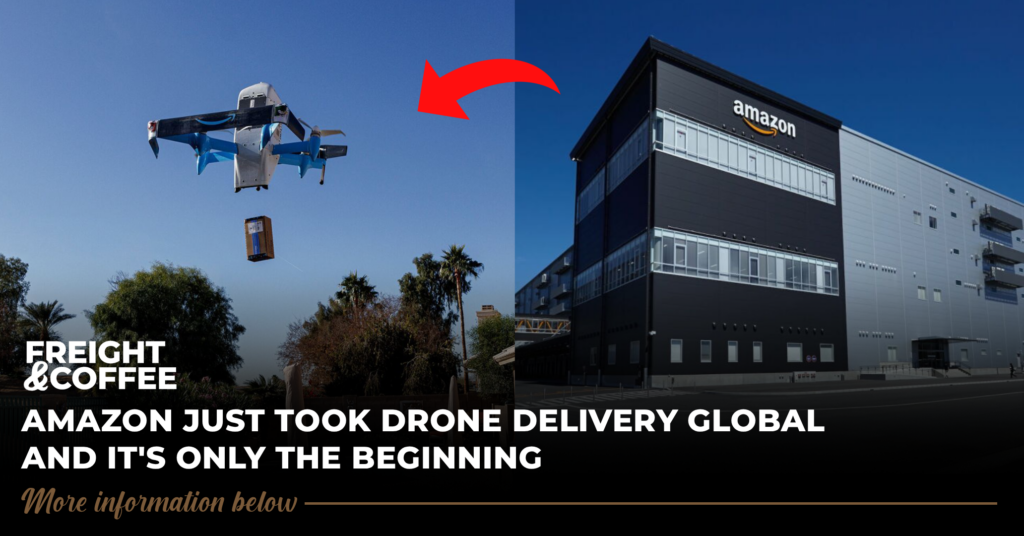
Breaking transportation news, August 17, 2026 — Amazon has officially crossed the Atlantic. For the first time in the history of Prime Air, the e-commerce giant is operating drone deliveries outside of the United States — and the implications for the future of last-mile logistics and supply chain technology are massive.
What’s Happening
Since February 2026, Amazon has been conducting drone deliveries from its large fulfillment center in Darlington, England. The program uses the MK30 drone — standing roughly five feet tall with a wingspan of about five and a half feet — capable of carrying packages weighing up to five pounds and reaching speeds of 70 mph.
According to reporting by FreightWaves, the service is currently available to customers with a garden, yard, or driveway within a 7.5-mile radius of the Darlington facility. Millions of products are already eligible. Delivery is completed within 60 minutes or less of the customer placing an order — the same speed promise Amazon Prime Air delivers in the U.S.
The U.K.’s Civil Aviation Authority has approved Amazon to conduct these operations, marking a significant regulatory milestone for commercial drone delivery in the country.
How It Works
The checkout experience is built around simplicity and safety. When a customer selects a drone-eligible item, they see a satellite map of their property showing pre-identified “delivery zones,” generated using Amazon’s AI and digital mapping systems. The customer picks a drop zone, is reminded to keep the area clear, and the drone does the rest.
Inside the Darlington fulfillment center, a mobile robot called Hercules retrieves the customer’s order and delivers it to a human associate, who packs it in Prime Air packaging. The drone then lifts off, navigates autonomously to the destination, descends while detecting and avoiding obstacles, and drops the package from a safe height. The Prime Air box includes customized cushioning technology at the bottom to protect the item on impact.
Real-time weather data is integrated into the checkout system — if conditions are unsafe for flight, the drone delivery option simply doesn’t appear. No confusion, no failed deliveries.
Two Years and 5,100 Flights to Get Here
The MK30 isn’t a prototype. Amazon’s engineers spent two years building it and conducted more than 5,100 flight tests totaling over 900 hours in the air, testing for high winds, unexpected obstacles, and edge-case scenarios. Every flight-critical system has a backup. The onboard perception system uses cameras and sensors to detect obstacles in real time — including objects that weren’t visible in satellite imagery during route planning.
“No single point of failure should ever cause it to lose control,” Amazon stated. That engineering philosophy is what earned regulatory approval — and what makes this deployment commercially viable at scale.
Why This Is Big News for Freight and Logistics
This isn’t just a tech story. This is a last-mile transportation breakthrough with direct implications for how goods move.
Drone delivery addresses one of the most expensive and inefficient parts of the supply chain: the final mile. Traditional ground transportation to residential addresses is slow, labor-intensive, and cost-heavy. A drone fleet operating from a strategically placed fulfillment center can serve a 7.5-mile radius in under an hour, at scale, without traffic delays, driver shortages, or fuel costs per stop.
Amazon is also investing billions of dollars in robotic warehouse technology across Europe to support this expansion. The Darlington center is a preview of what automated fulfillment feeding drone delivery could look like at a continental scale.
For the broader transportation and logistics industry, the message is clear: autonomous last-mile delivery is no longer a future concept. It’s operational, it’s regulated, and it’s scaling — starting today in the U.K.
What Comes Next
Prime Air in the U.K. is currently free as part of an Amazon Prime membership, but Amazon noted it will evaluate delivery fees in line with other premium speed services as the program expands to broader areas. The company is deploying drones at scale in 2026 across both the U.S. and now internationally — and Darlington is just the first stop outside American borders.
The question for every carrier, courier, and logistics provider watching this isn’t if drone delivery will reshape last-mile transportation. It’s how fast — and whether they’ll be ready.
Source: This article references reporting by Eric Kulisch for FreightWaves. Read the full original report at FreightWaves.
Freight & Coffee is your daily source for transportation news, breaking logistics news, supply chain updates, and freight technology insights — delivered through news, podcasts, and social media.
📷 Follow us on Instagram: @freightandcoffee