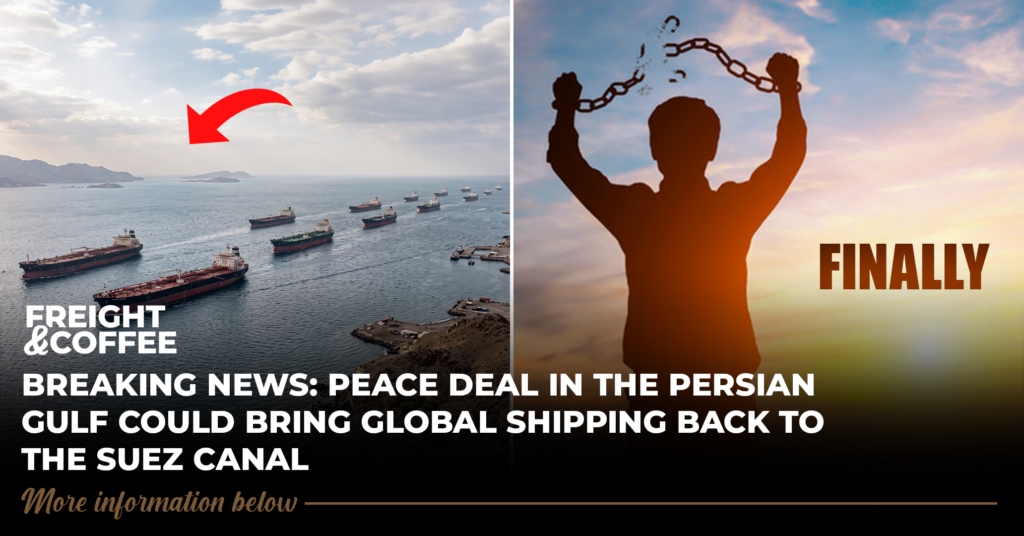
Big movement in ocean freight this week. Maersk, the world’s second-largest container line, announced it will begin routing one of its Gemini network services back through the Suez Canal — a signal that the broader shipping industry may finally be returning to one of the most important trade routes on the planet.
What Happened
Maersk confirmed that its AE15 service, operated jointly with Hapag-Lloyd, will shift from the long Cape of Good Hope route back to the trans-Suez corridor. The first vessel making the trip will be the Majestic Maersk, departing from Port Said on July 24. Maersk said the decision followed a careful review of security conditions in the Red Sea, describing it as a gradual step back toward normal operations through the corridor.
This is a major supply chain story because container and tanker lines have avoided the Red Sea since late 2023, after Yemen’s Houthi militia began targeting merchant vessels amid the Gaza conflict. Maersk actually tested the Suez route earlier this year, only to pull back again when tensions in the region flared back up.
Why It’s Happening Now
The shift comes as a tentative peace process between the United States and Iran appears to have calmed hostilities in the Strait of Hormuz — although vessel traffic through that waterway is still far below normal levels. It’s a fragile calm: just weeks ago, the Houthis warned of renewed attacks on Red Sea shipping, and last week the group threatened Saudi Arabia over alleged airspace violations involving an Iranian aircraft.
The Cost of the Diversions
The numbers show just how expensive the Red Sea detours have been for global logistics:
The Suez Canal makes up roughly 15% of Egypt’s total national revenue
Toll revenue dropped nearly 40%, falling from $47 million to $28 million in 2024
Container tolls fell 66%, and total vessel transits dropped about 38%
Other carriers are also testing the waters. French line CMA CGM has added several extra Asia-Europe sailings through the Suez, and Taiwan’s Wan Hai remains one of the few major carriers still using the route regularly.
Right now, roughly 780 vessels — representing 11.3 million TEUs of capacity — are still being routed the long way around Africa via the Cape of Good Hope. If the industry fully returns to the Suez, it could free up an estimated 120 ships, or about 1.7 million TEUs, equal to roughly 5% of the entire global container fleet.
Why This Matters for Transportation and Logistics
A full return to the Suez Canal would mean faster transit times between Asia and Europe, lower fuel and voyage costs for carriers, and potentially more stable freight rates across the ocean freight market. It’s one of the biggest supply chain developments to watch this year, and one that touches everything from container availability to global trade flows.
We’ll keep tracking this developing story as more carriers make their move. Stay tuned for more breaking news and transportation updates.
Freight & Coffee is your go-to source for transportation news, breaking news in logistics, podcasts, and social media coverage of the freight industry. Stay in the loop on supply chain, ocean freight, and everything moving the world forward.