
June 10, 2026 — Freight & Coffee Desk
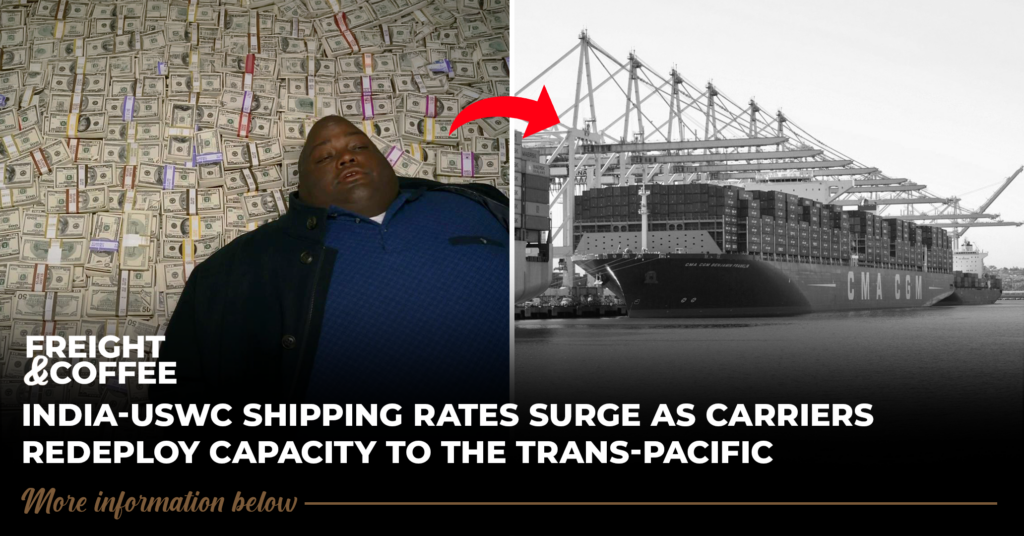
If you’re moving cargo from India to the US West Coast right now, your rate quotes are telling a story — and it’s not a pretty one. Freight rates on the India-USWC trade lane have spiked sharply in recent days, catching many shippers and importers off guard. But before you start blaming a sudden surge in demand, here’s what’s actually going on: the ships are simply leaving.
According to a new report by the Journal of Commerce, ocean carriers are actively pulling vessel capacity from the India-to-US West Coast corridor and redeploying those assets to the eastbound trans-Pacific trade out of China. The reason is straightforward — the trans-Pacific is paying better right now, and in the world of container shipping, profitability drives deployment decisions, not loyalty to a trade lane.
Freight forwarders on the ground are confirming what the numbers already show. This is not a demand story. Indian export volumes have not suddenly exploded overnight. What has changed is the supply side — fewer vessels, fewer sailings, tighter space — and when capacity shrinks on any trade lane, rates go up. It’s one of the most basic dynamics in ocean freight, and it’s playing out in real time on this corridor.
The broader context matters here. The trans-Pacific has been one of the most volatile and closely watched trade lanes in global shipping throughout 2025 and into 2026. Tariff-driven frontloading, aggressive blank sailings, and carriers actively managing capacity to protect margins have kept spot rates elevated on the China-to-US route. When a trade lane that dominant starts pulling resources from neighboring corridors, the ripple effects are felt fast — and India-USWC is feeling them now.
For Indian exporters, US importers, and logistics professionals managing South Asia supply chains, this is a critical breaking news moment. Rate spikes like this one don’t come with a courtesy email. They arrive when the vessels are already repositioned and your booking window is suddenly a lot smaller. The shippers who get hurt the most are the ones who assumed yesterday’s rates would still apply today.
The takeaway for your transportation and supply chain strategy is clear: stay close to your freight forwarder, monitor vessel schedules on your trade lanes, and build flexibility into your shipping calendar. In 2026, ocean carriers are operating with a level of network agility we haven’t seen before. They will move ships to where the margins are — and they will do it quickly.
This is the new reality of global logistics and container shipping. Trade lanes don’t exist in isolation. What happens on the trans-Pacific doesn’t stay on the trans-Pacific. It cascades across interconnected shipping networks, reshaping freight rates, availability, and lead times for shippers everywhere — including those moving goods between India and the United States.
At Freight & Coffee, we’ll keep tracking these freight news developments so you don’t have to watch the market alone. Because in this industry, information is just as valuable as a good rate — and a good cup of coffee doesn’t hurt either.
Stay informed. Stay ahead. Follow Freight & Coffee for daily freight news, breaking news, transportation updates, logistics insights, and supply chain analysis.
📍 Freight & Coffee — News · Podcasts · Social Media 📸 Instagram: @freightandcoffee
#transportation #freightnews #breakingnews #oceanfreight #containershipping #supplychain #logistics #transpacific #IndiaUSWC #freightrates #shippingnews #globallogistics #containerrates #supplychain2026